| Aquaria
/ 75Gallon: November
2002 - April 2004 |
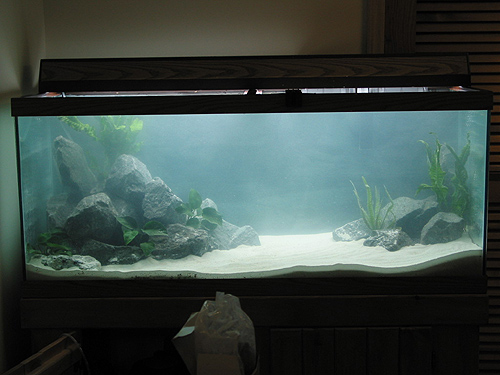
Dimensions: 48 x 18 x 20
Lighting: 2x48" 40Watt Triton NO T12
Lighting: 2x48" 40Watt GE Aqua Rays
NO T12 (used when taking pictures) Filtration/Circulation:
Eheim 2028 + AC 500 / 802 + 2x301 powerheads
Substrate: 100% Southdown Play sand
from HD
Heating: WON BROTHERS Pro Heat 500 Watt
Beauty, behaviour and simplicity of african lake cichlids made me want to
try a low-maintance african cichlid tank. I was debating on which species
to pick and which lake to imitate. Victorian Lake fish are a bit too aggressive
for my taste, although their coloration is extremely appealing, Tanganyika
Lake needed high PH/KH so at the end I chose Lake Malawi. I wanted to design
african-like theme, provide decent amount of space for fish and their hiding
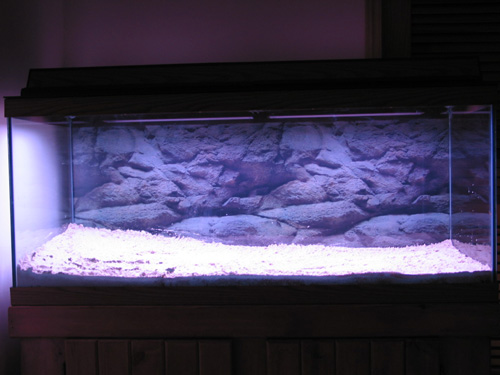
spots but unfortunetly I had limited space to work with. All Glass 75Gallon
tank, which provides plenty of depth - 18", was a perfect choice for this
project.
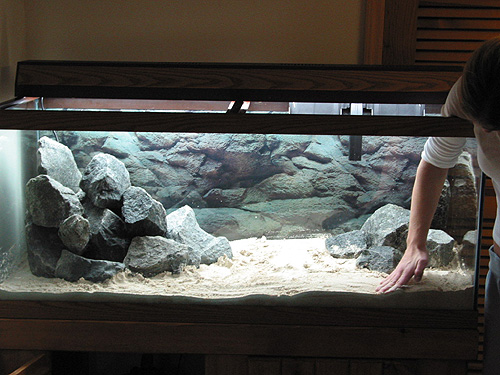
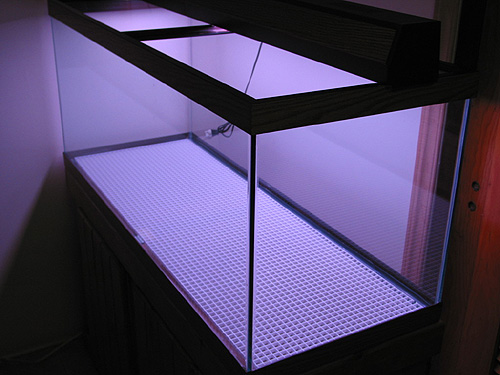
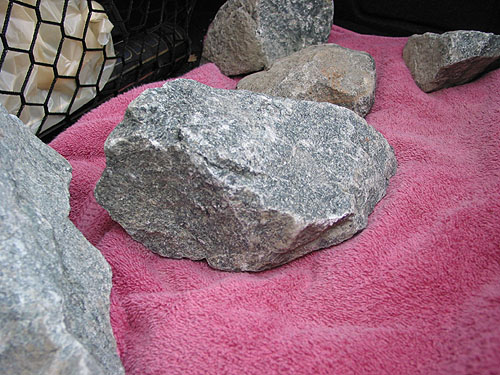
I used rocks that I found on the street (free !!!) and because of their
weight I had to use egg-crate, available in Home Depot (6$), to distribute
the mass throughout the bottom of the tank.
 |
 |
I used ~100lbs of Southdown Play Sand from Home Depot ($5 per 50lbs). This
specific brand has very fine texture and whitish color. Initially, I was
satisfied with the light color but if I was going to redo this project,
I would invest in darker colors. Fish looked a bit washed out and substrate
in every picture was overexposed. Fine texture of Southdown sand is another
element which should have been researched more carefully. Because of its
very fine texture, I had to move it around to prevent from "packing down"
and forming "dead spots".
It took about couple of hours to wash 100lbs of sand and at the end of the
project I felt like I wasted those couple hours and did nothing. Tank was
very cloudy I could barely see the background. That is when my good-old
Magnum 350 filter came to play and with its diatom filtration capability
I was able to remove smallest particles in matter of hours.
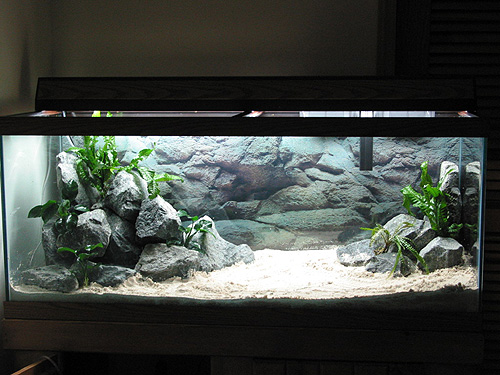
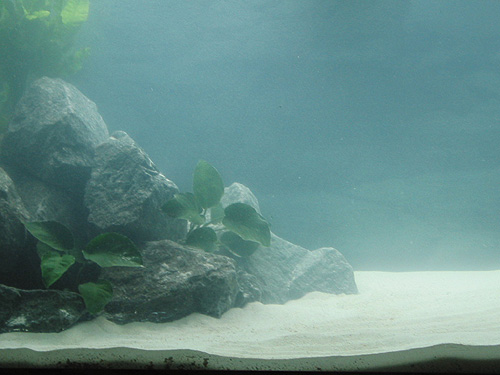
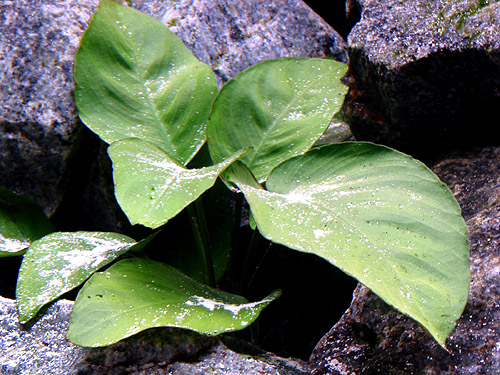
Flora was introduced as well to give more natural look. I found Anubias
sp. to be the easiest and hardest plants which could thrive in any environment.
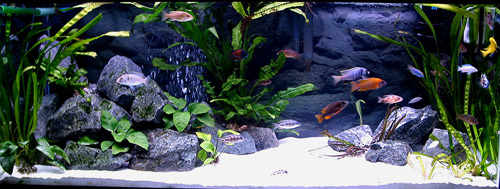
This tank was a home to Aulonocara sp., Haplochromine sp., Mbuna sp., and
some Tanganyika sp.: Aulonocara sp., Copadichromis borleyi, Sciaenochromis
fryeri; Placidochromis electra, Protomelas taeniolatus, Protomelas steveni,
Labidochromis caeruleus, Cyrtocara moorii, Neolamprologus brichardi
w/ fry.
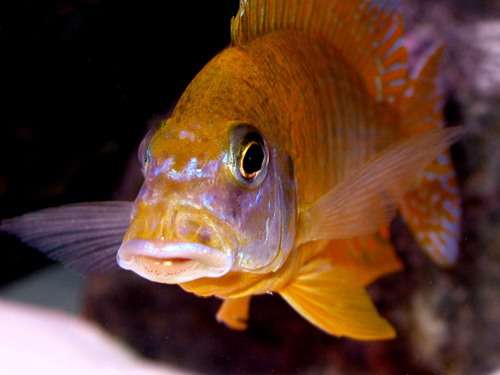
This Aulonocara baenschi was the "boss of the family". The holotype
(SMF 20041, Senckenberg Museum, Frankfurt) and the 15 paratypes of this
species were collected on 30 March 1983 by Stuart Grant at Nkhomo, Malawi,
which is 8 km east of the town of Benga. The species was named for Dr. Ulrich
Baensch, founder of TetraWerke, the German fish-food and aquarium products
company.
This setup was a perfect example of a low-maintance tank. I did weekly-50%
water changes (1 hour) to keep water quality and fed fish 3 times daily.
For the rest of the the week I enjoyed this little piece of Lake Malawi.
|